Hauniv.edu
  • Home
  • Academics
    • Undergraduate Programs
    • Graduate Programs
    • Certificate Programs
    • Course Catalog
    • School of Arts & Sciences
    • School of Social Sciences
    • School of Business, Technology & Engineering
    • Library
    • Faculty
    • Academic Calendars
    • Online Learning
  • Admissions
    • Overview of Admissions
    • Undergraduate Applications
    • Graduate Applications
    • Non-degree Applicants
    • Transfer Students
    • Financial Assistance
    • International Students
  • Student Services
    • Career Development
    • Counseling Center
    • Writing Center
    • Faculty Mentors
    • Civic Engagement
    • Office of Student Affairs
    • The Student Council
    • Debate Team
    • ACES
    • Alumni
    • Events Calendar
  • Research & Teaching
    • Research Institute
    • Conferences and Colloquia
    • Language Assessment
    • Center for Teaching Excellence
    • Research Ethics and Policies
  • Study Abroad
    • Overview of Study Abroad Programs
    • Study Abroad: Practical Details
    • Advanced Diploma in TESOL
    • Travel Study Programs
    • Academic Credits, Transcripts and Language Courses
  • About
    • Vision and Mission
    • Letter from the Dean of the Nashua Campus
    • Diversity, Equity, and Inclusion Plan
    • University Strategic Plan, 2022-2027
    • University Values
    • University Administration
    • University Office Directory
    • Board of Trustees
    • The Athens Campus
    • Academic Partnerships
    • Accreditation
    • Fact Sheet
    • Availability of Resources
    • Employment Opportunities
    • Latest News
    • Contact Us

  1. You are here:  
  2. Home
  3. facultys_all
  4. Academics
  5. Course Catalog

Master of Science in Sales Management (MSSM)

MSSM diagram

  • View the web page for the M.S. in Sales Management program

{slider=SM510 Business Finance for Sales Managers}Sales professionals involved in the domestic and international trade are required to combine different aspects of the market. Some of them are related to financial issues. It is of paramount importance to know the mechanism and risks associated with international markets. Any commercial activity requires a basic capacity of assessing the profitability and ability to appraise different exports / imports projects. Sales professionals should also fully understand the cost of funding for trading activity and assess the associated risks. Finally, they should be aware of the basic advanced financial instruments that facilitate their activities. Prerequisites: None, Credits 3{/slider}

{slider=SM520 Sales Management Strategies and Practices}The course aims at exploring alternative sales management strategies as well as sales processes and practices as part of a market-oriented strategic plan. More analytically, the course focuses on the effective and efficient line management of sales-reps, sales and forecasting techniques as preparation for effective selling practices, account and territory management, development of selling roles, sales -reps’ skills and competencies. Prerequisites: None, Credits 3{/slider}

{slider=SM530 Digital and Omni-channel Sales}The course provides students with the essential knowledge in competitively pursuing complex and key organizational accounts. The business to business (B2B) marketing and sales process is perhaps the greatest challenge for performing selling teams. The course also provides a trade marketing perspective since effective and creative interaction at the point of sale is of major significance for end-user attraction and retention. Students will also learn how to retain, add and grow valuable business, reflecting on a systematic, methodological and consistent business approach. Prerequisites: None, Credits 3{/slider}

{slider=BUS6277CCM Cross Cultural Management}The course induces students in cross cultural-management within a global, complex and demanding organizational environment. Students learn how to deal with culture, cultural values and cultural differences as major influences on ethics and ethical reasoning of sales. Prerequisites: None, Credits 3{/slider}

{slider=SM540 International Marketing and Sales Management}The course introduces students to marketing and sales operations in foreign markets, as well as to the cultural, political, and economic factors affecting the international marketer. The course focuses on marketing & sales planning and strategies in the international marketplace, and the impact that different cultures and environments have on business marketing and sales activities ending to the competitive position of a firm in the global economy. The course also discusses issues involved in creating, producing, pricing, and distributing products and services to an international consumer or an enterprise. Prerequisites: None, Credits 3{/slider}

{slider=SM550 Sales Analytics}The course provides a framework for analysing big data in all areas of business. It examines the role of statistics and forecasting in the business decision-making, planning process and sales. Topics include problem identification, data collection, data analysis and interpretation, and report preparation. Prerequisites: None, Credits 3{/slider}

{slider=SM560 Business and Strategic Management}The course provides concepts, tools and a framework for analyzing a business strategy. In today’s changing world, business strategy has to be reconsidered, attaining unique internal capabilities and searching for sustainable competitive advantage in the global and local terrain. Issues of an international business strategy are considered in the course as well as internationalized material in cases and examples. In addition emerging issues of strategy are considered in relation to corporate responsibility and ethics. The whole course utilizes case studies and practical examples to illuminate issues. Prerequisites: None, Credits 3{/slider}

{slider=BUS6124 Supply Chain Management}The course provides a holistic approach to end-to-end Supply Chain (SC) Management and focuses on both core SC principles, but also on key SC concepts to develop academic and hands-on knowledge. It also provides a full SC business understanding, but also emphasizes on cross-functional collaboration and integration between SC and the Commercial (Sales, Marketing) functions. It presents (via various means) the most important and challenging developments in SC systems and technology and connects Omni-Channel Customer Experience with SC Strategy. Prerequisites: None, Credits 3{/slider}

{slider=SM570 Advanced Seminars for Sales}The course is designed on a modular, seminar / workshop basis addressing a set of optimum sales managers’ competences. The course provides students with learning through multiple educational approaches incorporating in-class lectures, interactive workshops, role-playing, key sales managerial competences as provided by research findings. These key sales management set of competences include leadership, coaching and mentoring, communication and negotiation, work motivation, sales force recruitment, selection, training, development and evaluation (HRD approach). Prerequisites: None, Credits 3{/slider}

{slider=SM580 AI in Sales Management}In this course, students will gain essential knowledge and skills for effectively integrating Artificial Intelligence (AI) into business areas such as B2B, B2C and sales practices. With a focus on pursuing complex and key organizational accounts, students will explore how AI technologies can revolutionize territory account planning, new business opportunity identification, and marketing and sales solution development. Additionally, the course provides insights into strategic management of the marketing and sales mix for key accounts in both domestic and international markets. Prerequisites: None Credits 3{/slider}

{slider=SM590 Export Marketing and Sales}The course aims to explore alternative export sales management strategies as well as sales processes and practices as part of a market-oriented strategic orientation. The course focuses on the effective and efficient export international marketing and export line sales management, Market selection: definition and strategies, market entry strategies in depth with entry modes, Supply chain management/logistics and handling export orders. Prerequisites: None Credits 3{/slider}

{slider=SM592 Sales Engineering: Bridging Technical Sales and Business}This is an interdisciplinary status course which bridges technology and business. The course aims to prepare sales and technical experts in informatics and engineering to integrate and manage sales skills and competences with the fundamentals of technical solution selling / knowledge. Students will learn how to conduct effective product demonstrations and proof of concept and adopt communication and persuasion skills for technical as well as non-technical incumbents. Moreover, the students will realize and implement hands-on real-world applications the sales cycle in their industries. Prerequisites: None Credits 3{/slider}

Capstone Project (1 course, 3 credits – 6 ECTS)

{slider=SM6300 Capstone Project}MSSM students must develop a Capstone project toward the end of their studies. With the Capstone project, which can take the form of a Research or Consulting Project, students will demonstrate a command of the knowledge acquired in the MSSM program, the ability to conduct high-level analysis (with the application of simulation tools) of domestic and international sales management issues, and the capacity to make recommendations for the issues their investigation has revealed. The project also strengthens students’ competencies in critical analysis, and empirical investigation, as well as their skills in persuasion, argumentation and decision-making - all valuable for enhancing their professional careers. Prerequisites: Completion of all program requirements or permission by program director. To be taken in the last term of study. Credits 3{/slider}

Master of Science in Stress and Health Management (MSSHM)


MSSHM HAUniv


  •  View the web page for the M.S. in Stress and Health Management program


Core Courses

{slider=MSSHM501 Principles of Complexity, Homeostasis and Stress}

This course aims to introduce students to the basic concepts of stress. It begins with a thorough explanation of stress as an essential system for human survival and adaptation and presents the broad spectrum of internal/external stressors that challenge the internal equilibrium called homeostasis. Certain models of the stress-response physiology and the regulation mechanisms are presented, as well as the ways to effectively recognize and measure stress. Further topics include individual differences in the stress response, an overview of the pathophysiology generated by the chronic hyper-activation and chronic hypo-activation of the stress system, and the role of genetics and epigenetics in the current field of stress research. Students are expected to generate a written assignment on the basic concepts of stress and proceed to an oral presentation in class. Prerequisites: None Credits 3 {/slider}

{slider=MSSHM505 Biology and Psycho-Neuroendocrinology of Stress}

It examines the basic concepts of stress biology and medicine, emphasizing the field of psycho-neuroendocrinology. It begins with the pivotal mechanisms through which DNA is transcribed and translated to functional proteins, describes the anatomy and physiology of the central and peripheral nervous systems including the centers of the stress system and examines both the normal function and the dysfunction of the stress system. Learning topics include the mechanisms through which stress is associated with the so-called chronic non-communicable disorders. Separate lectures will cover the effects of stress on immune function, reproduction, and healthy and unhealthy aging. Students will learn the mechanisms of inter-cellular communication and the fundamental concepts of neurotransmitters and hormones. Finally, students learn to effectively apply stress management methods and to monitor their efficacy through specific biomarkers.Prerequisites: None Credits 3 {/slider}

{slider=MSSHM510 Research Design and Evaluation}

In this course students are given the opportunity to design and conduct research studies, analyze data, and evaluate research findings for their master thesis research proposal. Topics include types of variables and research design, procedures, instrumentation, and other forms of data collection. Methods applied to program evaluation are also discussed. Masters’ candidates are expected to generate academically sound research proposals, according to the American Psychological Association standards, for their investigation that constitutes the basis for a final thesis project.
Prerequisites: None Credits: 3 {/slider}

{slider=MSSHM515 Statistics and Hypothesis Testing}

This course presents various methods and designs that give students the opportunity to conduct research studies, analyze data and evaluate research findings. Topics such as exploratory data analysis, sampling, and probability theory, statistical inference for hypothesis testing, ANOVA, correlation and power, and the principles of descriptive, inferential, univariate, and multivariate statistics will be covered. Students are given ample practice in a lab setting, that provides for the necessary experience required for their research dissertations. Prerequisites: None Credits: 3{/slider}

{slider=MSSHM520 Health Promotion Principles and Practice}

Provides an overview of health promotion theory, equipping students with the conceptual and practical skills to effectively incorporate health promotion into their everyday practice. It begins with exploring the concepts of health, disease, and well-being, and progresses to the emergence of health promotion as a key strategy for health protection and empowerment. Topics include health behavior modification, health inequalities, the World Health Organization (WHO) healthy settings approach, and media approaches in health promotion. Finally, students learn how to effectively design, implement, and evaluate a health promotion intervention or program. Prerequisites: None Credits 3 {/slider}

{slider=MSSHM525 The Role of Stress in Health and Disease}

This course examines the profound role of prolonged, frequent and intense stress exposure in health and disease. Using up-to-date scientific data, it explores the relations and the underlying mechanisms between stress and a range of disorders that formulate the current prevalent pattern of morbidity and mortality in modern societies. Topics include manifestations of the psychological and somatic burden of distress, which is associated with the so-called chronic non-communicable disorders that plague modern societies, such as anxiety, depression, obesity, metabolic syndrome, hypertension, dyslipidemia, osteoporosis, diabetes mellitus, cardiovascular disease, autoimmune/allergic disorders, sleep disorders, cancer, and vulnerability to certain infections. By synthesizing theories and research findings, it also points out the magnitude of behavioral distress, that are expressed as top risk behaviors such as smoking, sedentary lifestyle and poor dietary choices. Prerequisites: None Credits 3 {/slider}

{slider=MSSHM532 Adaptation and Stress Response to Climate and Societal Challenges}

This interdisciplinary course explores the impact of socio-environmental and climate-related stressors on the human stress system and mental health. Students will examine the biological, psychological, and sociocultural mechanisms by which modern stressors—such as urbanization, pollution, digitalization, economic instability, social isolation, and climate change—affect individual and collective well-being. The course incorporates theoretical frameworks from neuroscience, public health, psychology, and environmental studies, and emphasizes evidence-based strategies for stress management. Special focus is given to post-pandemic realities and the increasing prevalence of chronic stress in contemporary life. Through case studies, critical analysis, and applied discussions, students will be equipped to understand and respond to stress in diverse societal and occupational contexts. Prerequisites: None Credits 3{/slider}

{slider=MSSHM535 Evidence-Based Stress Management}

This course introduces students to the science of stress management providing them with an overview of the available evidence-based stress management techniques and coping strategies. Given the profoundly negative impact of stress, it is important for professionals to master a repertoire of stress management techniques. Topics include coping strategies based on cognitive behavioral modification, time management and a broad repertoire of relaxation techniques, including diaphragmatic breathing, different types of meditation, mental imagery, and progressive muscular relaxation among others. Through numerous examples, exercises and solid research findings, students shall develop essential knowledge and skills to effectively apply the different stress management approaches to clinical and non-clinical populations and to facilitate self-development. Prerequisites: None Credits 3 {/slider}

{slider=MSSHM540 Thesis Research and Completion}

All master degree candidates should carry out a research project in a topic of their interest relevant to stress science and health promotion. Students are expected to conduct a thorough research project with a specific purpose and hypothesis. The project must include review of the relevant professional literature, systematic data collection, analysis and interpretation, and professional write-up. To successfully complete the course, the master degree candidate will prepare and present a publication-ready manuscript and make an oral presentation. Prerequisites: None Credits 3 {/slider}

Elective Courses

{slider=MSSHM512 Foundations of Counseling}

This course examines different therapeutic approaches and techniques that focus on the foundational concepts necessary for working with individuals, groups, and families. Attention is given to the development of professional identity and client relationships, case conceptualization, principles and professional standards that apply to the rules of ethical behavior, and the necessary skills required in psychotherapy and counseling.
Prerequisites: None Credits: 3{/slider}

{slider=MSSHM517 Leadership and Organizational Behavior}

Focuses on the behavior of people at work as well as the way they interact in the organizational environment with effects on organizational performance and effectiveness. It examines different systems, structures, and processes, and is divided into two modules moving from individual behavior to the organization with emphasis on leading change. Topics include self-awareness, work attitudes, emotions, organizational dynamics, and new leadership roles as ambidexterity, agility and managing complexity. Prerequisites: None Credits 3 {/slider}

{slider=MSSHM522 Project Management}

Introduces students to methodologies for managing projects within an organizational context, including the processes of initiating, planning, executing, controlling, reporting and closing a project. The course investigates project variables such as scope, time and cost, topics of project integration, quality control, and risk management, the management of changes in organizations that introduce or service information systems. Students learn how to identify project champions, work with user teams, and document project management. Prerequisites: GE105, GE106, GE115 Credits: 3 {/slider}

{slider=MSSHM530 Stress Manifestations over the Life Course}

This course examines the role of stress over the life course and discusses its manifestations in different organizational settings. It begins with the effects of stress on health at the very start of life and progresses to explore its impact during infancy, adolescence, adulthood and at the older age. Except for age-related transitions it examines those which entail a social role entry or exit and specifies the kinds of transitions that are potentially important to people’s wellbeing. Stress manifestations in different organisational settings and institutions including family, education, physical and social environment are also thoroughly presented. Special emphasis is given on the working environment and the magnitude of occupational stress as a major and distinct component of the stress research. Prerequisites: None Credits 3 {/slider}


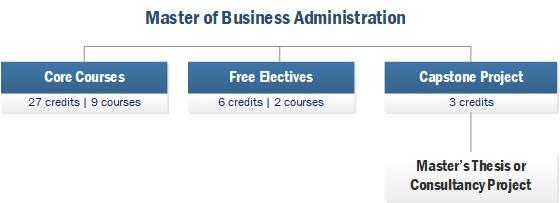
Master of Business Administration (MBA)

ΜΒΑ hauniv v2

  • View the web page for the Master of Business Administration program

Core Curriculum (9 courses, 27 credits – 54 ECTS)

{slider=BUS501 Functional Skills Integration}Students are engaged in interactive seminars and workshops that reshape how they think, act, and perceive themselves. Through feedback and self-reflection, students focus on their emotional intelligence and develop a growing awareness of their own styles of professional conduct and management. Prerequisites: Completion of all MBA core courses or permission by program director. To be taken in the last term of study. Credits: 3{/slider}

{slider=BUS511 The Business Landscape}Provides a holistic view of an enterprise framed through the basic concepts of management functions. Contemporary business challenges are identified and studied, focusing on how to address issues and exploit opportunities in a competitive business environment. Prerequisites: None Credits: 3{/slider}

{slider=BUS513 Business, Policy and the International Economy}Focuses on the fundamental economic concepts necessary for managerial decision making and how those interplay with business policy. It introduces tools which are essential for understanding the global economic environment within which businesses operate and focuses on how optimal business decisions should be made by taking into consideration economic factors. Prerequisites: None Credits: 3{/slider}

{slider=BUS526 Marketing Management}Provides an overview of marketing processes and principles, and gives students the opportunity to apply the key marketing concepts to real-business situations. The course teaches students to identify and explore the significance of market needs, to plan for the development of goods and services, to organize communication campaigns, and to develop marketing strategy for internationalization of the enterprise. Topics include the development of commercial relationships, building successful brands, and strategic market planning. Prerequisites: None Credits: 3{/slider}

{slider=BUS527HR Strategic Human Resources Management}Provides a thorough understanding of how people are managed at work. The focus is on key HR practices and activities ranging from job analysis to training and rewards systems. Additional critical, applied, and theoretical contemporary HR approaches such as flexible working, outsourcing, employee involvement and commitment at the work place are also discussed. Prerequisites: None Credits: 3{/slider}

{slider=BUS528 Managerial Finance}Introduces students to the principles of managerial finance. The course covers the basic principles of corporate finance and the elements needed for financial management, planning, decision-making, and valuation in a business enterprise. The areas of study include: financial markets and instruments, time value of money, valuation of assets and projects under certainty and uncertainty, and corporate financing policy. It concludes with a critical approach of the mergers and acquisitions strategies in the modern financial environment. Prerequisites: None Credits: 3{/slider}

{slider=BUS6109 Accounting for Decision Making}Explores financial and managerial accounting and procedures, with a focus on the content, analysis, and interpretation of financial and management accounting information. Topics include techniques and tools for planning, control, and decision making in an effort to achieve organizational goals. Prerequisites: None Credits: 3{/slider}

{slider=BUS6110 Operations Research}Provides a framework for conducting research in a scientific manner in all areas of business. It examines the role of statistics and forecasting in the business decision-making and planning process. Topics include problem identification, research design, data collection methods, sample design, data analysis and interpretation and report preparation. Prerequisites: None Credits: 3{/slider}

{slider=BUS6120 Strategy}Strategy definition and dissemination within a firm are discussed in this course using a multilevel approach. Intra-industry analysis, resources and capabilities analysis, and understanding of sustainable competitive advantage are explored. Prerequisites: None Credits: 3{/slider}

Elective Curriculum (2 courses, 6 credits – 12 ECTS)

People Management Certification

{slider=BUS512 Leadership and Organizational Behavior}Focuses on the behavior of people at work as well as the way they interact in the organizational environment with effects on organizational performance and effectiveness. It examines different systems, structures and processes, and is divided into two modules moving from individual behavior to the organization with emphasis on leading change. Topics include: self-awareness, work attitudes, emotions, organizational dynamics, and new leadership roles as ambidexterity, agility and managing complexity. Prerequisites: None Credits: 3{/slider}

{slider=BUS514 Ethics, Law and CSR}Provides an understanding of the fundamental principles and laws that form the legal environment in which all businesses function, as well as of important legal issues that may affect day-to-day business activities. Areas of study include legal issues concerning internal and external stakeholders (personnel, customers, suppliers and competitors). Topics in ethics to be discussed include the special responsibilities of professionals, the obligations of corporations concerning the environment and product safety, and employee rights. Emphasis will be given to the mastery of representative ethical systems and concepts, and their application to real-life situations. Prerequisites: None Credits: 3{/slider}

{slider=BUS516 Total Rewards}Provides an understanding for the reward functions that contemporary organizations implement. It examines various compensations and benefits strategies offering a multinational perspective for total and flexible rewards dominate the global market place. Topics include: job analysis, wage scales, pension and benefits, incentives, HRIS systems, compensation and benefit planning and profit sharing. Prerequisites: None Credits: 3{/slider}

{slider=BUS517 Employment Relations}Emphasizes the aspects of employment relations from both a US and a European perspective. It provides students with an overview of the legal framework at work discussing the regulatory revolution, employment contracts, discrimination, equal opportunity and diversity as well as discipline and grievance. Other topics also include: collective bargaining, employee involvement and participation and special topics on unionism, conciliation and arbitration, and redundancy procedures. Prerequisites: None Credits: 3{/slider}

Operational Excellence Certification

{slider=BUS518 Business Analysis & Service Management}Covers the principles of Business Analysis as defined by IIBA and Service Management as defined by ITIL. Beyond the theoretical background, a practical approach is adopted in order to provide an understanding of the way these principles are applied in order to achieve operational excellence. Prerequisites: None Credits: 3{/slider}

{slider=BUS6111 Technology and Operations Management}Explores service management, business analysis and operations management. Essential knowledge of standard frameworks for service management (ITIL), business analysis (BABOK) and project management (PMBOK) in the context of decision making are discussed. It also focuses on the importance of technology and information use in decision making, and the achievement of organizational goals. Prerequisites: None Credits: 3{/slider}

{slider=MGT6126 Project Management}Covers the management of projects within an organizational context, including the processes related to initiating, planning, executing, controlling, reporting, and closing a project. Project integration, scope, time, cost, quality control, and risk management are also explored. Managing the changes in organizations resulting from introducing or revising information systems is examined, as are identifying project champions, working with user teams, training, and documentation. Prerequisites: None Credits: 3{/slider}

{slider=BUS6124 Supply Chain Management}The course provides a holistic approach to end-to-end Supply Chain (SC) Management and focuses on both core SC principles, but also on key SC concepts to develop academic and hands-on knowledge. It also provides a full SC business understanding, but also emphasizes on cross-functional collaboration and integration between SC and the Commercial (Sales, Marketing) functions. It presents (via various means) the most important and challenging developments in SC systems and technology and connects Omni-Channel Customer Experience with SC Strategy. Prerequisites: None Credits: 3{/slider}

Digital Marketing Certification

{slider=BUS519 Digital Marketing Analytics}Focuses on understanding and implementing the digital media landscape and digital analytic concepts. The course explores the digital marketing tools including: e-mail marketing, newsletter release, social media listening, Search Engine Optimization (SEO) analytics, conversion optimization, digital content management – web site architecture and consumer engagement analytics in creating marketing decision making. The course focuses on legal and ethical issues of digital marketing. The course focuses on using digital marketing analytics in formulating effective and efficient company–customer quality relationships, new product development. The course optimally leads to On-Line Marketing Certified Associate (OMCA). Prerequisites: None Credits: 3{/slider}

{slider=BUS520 Integrating Marketing in a Digital Age}Introduces students to on-line / off-line marketing operations in various business markets. The digital era is strongly affecting marketing practices, and regardless of the industry, sector, or geography, the marketing student needs to understand the power of digital marketing strategies, tools and techniques. The course focuses on relationship marketing theory as the means of a service– dominant business approach into the markets. In addition, the course explores digital marketing planning and implementation practices, reporting and the impact digital marketing management has on differentiated marketing activities. Prerequisites: None Credits: 3{/slider}

{slider=PR6241 Strategic Communication and Public Relations}Students are introduced to public relations as a strategic, planned process to influence public opinion through sound character performance, based on mutually satisfactory two-way communication. The course covers the Public Relations functions that help an organization and its publics to mutually adapt to each other. Topics include: strategic communication, media relations, the management of issues (crisis management), community relations, consumer relations, international relations, and public opinion management. Prerequisites: None Credits: 3{/slider}

{slider=PR6250 Branding and Communications}Introduces students to the principles of branding and integrated marketing communications. The course familiarizes students with the practice of marketing communications and its role in creating value for the firm and its stakeholders. Special reference is made to advertising, media planning, and the differences between marketing and public relations. Furthermore, it introduces students to current applications of integrated communications practice in the competitive environment. Prerequisites: None Credits: 3{/slider}

{slider=SM580 AI in Sales Management}In this course, students will gain essential knowledge and skills for effectively integrating Artificial Intelligence (AI) into business areas such as B2B, B2C and sales practices. With a focus on pursuing complex and key organizational accounts, students will explore how AI technologies can revolutionize territory account planning, new business opportunity identification, and marketing and sales solution development. Additionally, the course provides insights into strategic management of the marketing and sales mix for key accounts in both domestic and international markets. Prerequisites: None Credits 3{/slider}

Μanagement Information Systems Certification

{slider=IT6264 IT Management and Strategy}Presents management and strategic perspectives for aligning competitive strategy, core competencies, and information systems. The course explores the development and implementation of policies and plans to achieve organizational goals. It defines the systems that support the operational, administrative, and strategic needs of the organization, its business units, and individual employees. Students learn approaches to managing the information systems function in organizations, including examination of the dual challenges of effectively controlling the use of well-established information technologies, while experimenting with selected emerging technologies. Prerequisites: None Credits: 3{/slider}

{slider=IT6125 Decision Support Systems}Addresses the role of management support systems in decision-making within organizations by combining data, sophisticated analytical models and tools, and user-friendly software into a single powerful system. Data from internal and external sources are examined to help monitor organizational performance, track activities of competitors, spot problems, identify opportunities, and forecast trends. Topics include data mining, artificial intelligence techniques, and agent technologies. Prerequisites: None Credits: 3{/slider}

{slider=IT6262 Systems Analysis and Design}Covers the systems development life cycle, analysis and design techniques, requirements collection and structuring, process modeling, data modeling, design of interface and data management, and middleware design. Students will use current methods, tools, and methodologies including the latest UML platforms, prototyping & visual development. Prerequisites: None Credits: 3{/slider}

{slider=IT6122 E-Business and E-Commerce Management}Provides instruction in all aspects of e-business operations, from front-office marketing, commerce, sales and customer service, to back-office operations, including human resource administration and supply-chain management. Additionally, emphasis will be placed on the use of e-business models to enable the Internet to function as a trusted medium for carrying on day-to-day business activities and enhance the performance of an organization. Prerequisites: None Credits: 3{/slider}

Other Business Electives

{slider=BUS529 Managing for Sales}Aims at exploring alternative sales management strategies as part of the people management competency of the MBA program as well as sales applications and practices within a competitive business environment. More analytically, the course focuses on effective and efficient line management of sales-reps, sales and forecasting techniques as preparation for effective selling practices, account and territory management, development of selling roles, skills and competencies. Finally, the course examines the role of selling within the Customer Relationship Management framework and hence, building of long-lasting business relationships. Prerequisites: None Credits: 3{/slider}

{slider=BUS6277CCM Cross Cultural Management}Focuses on negotiation in the global business setting, on culture and negotiation strategy, culture and negotiators' interests, and culture and negotiation ethics. It also covers factors such as dispute resolution venue, currency, and having government on the other side of the table. Prerequisites: None Credits: 3{/slider}

{slider=GM6271 International Business}Provides an overview of the environment, structures, and systems that are the basis for international business. Students are exposed to the geography, cultures, economies, politics, and other infrastructures of major market areas of the world. The course develops team and individual organizational skills and capabilities in intercultural communication, strategic management, and the negotiation, implementation and evaluation of international business issues. Prerequisites: None Credits: 3{/slider}

{slider=GM6274 International Marketing}Examines the challenge of entering and operating effectively in foreign markets. It investigates how decisions need to be made regarding international marketing objectives, strategies and policies, foreign market selection, adaptation of products, distribution channels of communications to fit each foreign market, and systems of international marketing organization, information gathering, planning and control. Prerequisites: None Credits: 3{/slider}

{slider=MGT6130 Entrepreneurship and New Venture Management}Offers a framework for understanding the entrepreneurial process, and exposes students to challenges, problems, and issues faced by entrepreneurs who start new ventures. Major objectives are for students to learn how to identify and evaluate business opportunities, develop a business concept and marketing plan, assess and obtain the required resources, manage the growth of new ventures, and plan exit strategies. Prerequisites: None Credits: 3{/slider}

{slider=PR6248 Crisis Management}Offers an attitude adjustment about crises. The course uses crises case studies and real-time crisis scenarios to teach students sound planning and crisis forecasting techniques. A practical, business-oriented overview introduces students to strategic communication techniques on how to avoid interfering with normal operations of business and falling under media scrutiny, and how to protect the corporate image or a company’s bottom line during a crisis situation. Prerequisites: None Credits: 3{/slider}

Capstone Project (1 course, 3 credits – 6 ECTS)

{slider=CP6300 Capstone Project}Students demonstrate knowledge and skills integration acquired across the MBA program, the ability to conduct high level analysis of business issues, and to develop robust recommendations and solutions to the business issues they investigate. Through the project, students hone their critical analysis, empirical investigation, managerial argumentation, decision making, persuasion and project management skills, valuable for the enhancement of their professional careers. Prerequisites: Completion of all program requirements or permission by program director.
To be taken in the last term of study. Credits: 3{/slider}

Master of Science in Informatics (MSI)

MSI hauniv diagram

  • View the web page for the M.S. in Informatics program

Informatics Core

The Informatics core consists of four courses and a Master’s thesis:

{slider=IT6260 Database Management Systems}

Covers the concepts, principles, issues and techniques for managing corporate data resources. Students learn techniques for managing the design and development of large database systems including logical data models, concurrent processing, database administration, data distribution, integrity, security and access are examined. Topics include data modeling, SQL and database architectures and implementations, data warehousing, data cleansing, and data mining. Major database products like Oracle, DB2, SQL Server 2005, along with open source solutions, are comparatively presented and evaluated. Prerequisites: None Credits: 3{/slider}

{slider=IT6261 Data and Communication Networks}

Covers telecommunications fundamentals, including data, voice, image, and video. The concepts, models, architectures, protocols, standards, and security for the design, implementation, and management of digital networks are examined. The essentials of local area networks (LAN), metropolitan area networks (MAN), and wide area networks (WAN) are covered, as well as both transmission and switching efficiency. Also covered are regulatory and technical environments. Topics include security and authentication, network operating systems, e-commerce and associated web sites and practices, and middleware for wireless systems, multimedia, and conferencing. Prerequisites: None Credits: 3{/slider}

{slider=IT6262 Systems Analysis and Design}

Covers the systems development life cycle, analysis and design techniques, requirements collection and structuring, process modeling, data modeling, design of interface and data management, and middleware design. Students will use current methods, tools, and methodologies including the latest UML platforms, prototyping & visual development. Prerequisites: None Credits: 3{/slider}

{slider=IT6264 IT Management and Strategy}

Presents management and strategic perspectives for aligning competitive strategy, core competencies, and information systems. The course explores the development and implementation of policies and plans to achieve organizational goals. It defines the systems that support the operational, administrative, and strategic needs of the organization, its business units, and individual employees. Students learn approaches to managing the information systems function in organizations, including examination of the dual challenges of effectively controlling the use of well-established information technologies, while experimenting with selected emerging technologies. Prerequisites: None Credits: 3{/slider}

{slider=IT6300 Master’s Thesis}

Aims to expose students to real-life situations encountered in business environments through the development of original and practical applications. The Thesis will enable students to gain experience in all phases of the implementation and management of information systems, applying the knowledge and skills they have acquired in different course modules. Alternatively, students can opt to do an in-depth study of a research topic, including bibliographic review and the development and implementation of the technological aspects of the topic, as preparation for writing the thesis. Students select a topic of interest and a personal supervisor for completing the Master Thesis. Prerequisites: Completion of all core requirements or permission by program director. Credits: 6{/slider}

This requirement consists of 18 graduate credits. Τhese five courses are the basis for an Informatics degree since they form the basis of modern information systems. The Master’s Thesis aims to expose students to real-life situations encountered in business environments through the development of original and practical applications. Alternatively, students who are inclined towards research can learn advanced techniques and practices used in Informatics by participating in faculty-supported research.

Business Computing and Big Data Analytics

Students may concentrate in the field of Business Computing and Big Data Analytics by selecting 6 elective courses from the following group of courses:

{slider=IT6122 E-Business and E-Commerce Management}This course provides instruction in all aspects of e-business operations, from front-office marketing, commerce, sales and customer service, to back-office operations, including human resource administration and supply-chain management. Additionally, emphasis will be placed on the use of e-business models to enable the Internet to function as a trusted medium for carrying on day-to-day business activities and enhance the performance of an organization. Prerequisites: None Credits: 3{/slider}

{slider=IT6263 E-Business Technologies}Offers students the opportunity to explore modern design methodologies that allow for the development of scalable and decoupled components. Technologies such as XML, Web Services and Enterprise Development Environments will be investigated. The course investigates current IT trends and methodologies that yield efficient and effective solutions to sustain a competitive edge in today’s businesses. Students will be able to synthesize and select the appropriate technology to engineer modern enterprise solutions. Prerequisites: None Credits: 3{/slider}

{slider=IT6267 Electronic Commerce Programming}Explores programming techniques for web and e-commerce program development. The courses develops students’ programming skills with HTML, dynamic HTML, animation, graphics, JavaScript, VBScript, CSS, XSL, ASP, ActiveX Data Objects, session tracking, cookies and shopping carts. Students are shown applications of e-commerce programming to various e-business models. Prerequisites: None Credits: 3{/slider}

{slider=IT6274 Data-mining and Data-Warehousing}Covers the fundamentals of data warehousing architecture and the issues planning, designing, building, populating, and maintaining a successful data warehouse. In addition, data mining is introduced and linked with the data warehouses. Various topics include logical design of a data warehouse, the data staging area, and the use of multidimensional analysis using OLAP techniques, as well as future trends in data mining. Various data mining systems are presented. (3 Credits){/slider}

{slider=IT6277 Artificial Intelligence & Neural Networks}Introduces the basic concepts and methods of artificial intelligence (AI) and neural networks (NNs) from a computer science perspective. Students learn how to design AI and NNs models for different applications. Emphasis is given on the selection of data representations and algorithms useful in the design and implementation of intelligent systems. Students participate in lectures and discussions on various topics, including heuristic, logical and probabilistic reasoning, planning, learning, and perception. Advanced topics are selected from areas such as robotics, vision and neural networks. (3 Credits){/slider}

{slider=IT6530 Graph Theory}This course covers the basics of graph theory; the objective is to build the strong background required for students enrolled in the social networks program. The material to be covered includes: Fundamental concepts of graphs; Classification of nodes and links; Vector spaces and graphs; Topological parameters: packings and coverings; Connectivity; Hamilton graphs; Graph factorization; Graph coloring; partite graphs; and folding. Prerequisites: None Credits: 3{/slider}

{slider=IT6535 Sales Engineering: Bridging Technical Sales and Business}This is an interdisciplinary status course which bridges technology and business. The course aims to prepare sales and technical experts in informatics and engineering to integrate and manage sales skills and competences with the fundamentals of technical solution selling / knowledge. Students will learn how to conduct effective product demonstrations and proof of concept and adopt communication and persuasion skills for technical as well as non-technical incumbents. Moreover, the students will realize and implement hands-on real-world applications the sales cycle in their industries. Prerequisites: None Credits 3{/slider}

{slider=IT6537 Visual Analytics with SAS Viya}This advanced course in business analytics introduces graduate students to corporate data preparation, data discovery and report creation employing SAS Viya platform. This course can also help preparing the graduate student to take the following SAS certification exams: SAS certified specialist: SAS visual business analytics 7.5/8.3. Prerequisites: None, Credits: 3{/slider}

{slider=IT6540 Investigative Data Mining}This course presents models, methods, and techniques for studying and analyzing Criminal Networks. More specifically, mathematical and computer science methods and techniques to fight crime are presented, such as information harvesting and integration, Modeling Criminal Activity, Strength of Structures of Small Sizes, Qualitative and Quantitative Temporal Reasoning, and others. (3 Credits){/slider}

{slider=IT6545 Pattern Analysis and Detection}The objective of this course is to present the fundamentals of pattern analysis and detection in numerical data. Topics include techniques for handling multidimensional data of various types and scales along with algorithms for clustering and classifying data. Decision theory, statistical classification, maximum likelihood and Bayesian estimation, Linear Discriminant Functions, Multilayer Neural Networks and Stochastic Methods will be also discussed. Prerequisites: None Credits: 3{/slider}

{slider=IT6550 Social Network Analysis and Mining}This course introduces students to the basic concepts and techniques in social networks analysis. Students learn how and when to apply different metrics for social network analysis. Topics to be covered include: identifying key individuals and groups in social systems; detecting and generating fundamental network structures, studying hidden communities, and modeling growth and diffusion processes in networks. Students will learn how to use different tools for social network analysis. Prerequisites: None Credits: 3{/slider}

{slider=IT6560 Game theory}Game theory is a branch of Mathematical Economics that studies strategic interactions amongst rational decision makers. Traditionally, game theoretic tools have been applied to solve problems in Economics, Business, Political Science, Biology, Sociology, Computer Science, Logic, and Ethics. In recent years, applications of game theory have been successfully extended to several areas of engineered / networked system such as wireline and wireless communications, static and dynamic spectrum auction, social and economic networks. This course is intended to provide students with a comprehensive treatment of game theory with specific emphasis on applications in Economics and Engineering. Prerequisites: None. Credits: 3{/slider}

{slider=MGT6126 Project Management}Covers the management of projects within an organizational context, including the processes related to initiating, planning, executing, controlling, reporting, and closing a project. Project integration, scope, time, cost, quality control, and risk management are also explored. Focus is given to the IT area. Hands-on experience on using a Project Management tool is provided. Prerequisites: None Credits: 3{/slider}

This group of courses will provide students with the basic knowledge in the area of big data analysis and business computing, and will enable them to participate in research projects in the field. This group of courses also focuses on technical, organizational, and managerial issues at the enterprise level as a whole, on a day-to-day basis.

Applications and Software Development

Students may concentrate in the field of Applications and Software Development by selecting 6 elective courses from the following group of courses:

{slider=IT6125 Decision Support Systems}Addresses the role of management support systems in decision-making within organizations by combining data, sophisticated analytical models and tools, and user-friendly software into a single powerful system. Data from internal and external sources are examined to help monitor organizational performance, track activities of competitors, spot problems, identify opportunities, and forecast trends. Topics include data mining, artificial intelligence techniques, and agent technologies. Prerequisites: None Credits: 3{/slider}

{slider=IT6265 Enterprise Systems Applications}Introduces business processes and the integration of Enterprise Systems with a focus on the core modules of financial accounting, cost management, materials management, sales and distribution, and production planning and control. The course will build an understanding of enterprise system processes and configuration activities, which occur in companies using Enterprise Systems. Students will understand the business activities that these systems support, allowing them to be prepared for business, technical, or system support roles. Hands-on experience and demonstrations of successful Enterprise System such as SAP S/4HANA, will be provided so that students can put into practice the theory that supports business activities. Prerequisites: None Credits: 3{/slider}

{slider=IT6266 Application Development Environments and Technology}Covers object-oriented and procedural software engineering methodologies that bring together key technologies and insights for the development of robust, reliable, enterprise-class Web and distributed applications. Major technology solutions such as .NET and J2EE. are presented. Prerequisites: None Credits: 3{/slider}

{slider=IT6268 Information Technology Hardware and Software}Students will gain an in-depth exposure to information technology hardware and software components and their interaction. A systems view of computer systems will be used to identify computer and telecommunication system components. Peripheral devices will be described and principles of operation will be studied and learned. The operating system software, including I/O drivers, and telecommunication applications and extensions to the operating system will be examined and utilized. Organization of the operating system will be studied to understand how concurrent processes, scheduling, memory management, and I/O are accomplished. Telecommunication devices will be identified and system integration considerations will be presented. Finally, switches, multiplexers, and media will be explored as basic components of telephone, LAN, and WAN systems. Prerequisites: None Credits: 3{/slider}

{slider=IT6270 Human-Computer Interaction}Provides a detailed understanding of the principles and practices involved in the creation and implementation of user interfaces and, more specifically, the theory and practice of human computer interaction. Students learn how to design, implement, and evaluate human computer interaction and become familiar with the most common toolkits used in user interface design. The course focuses on usability and accessibility, presenting the most common usability methods and accessibility guidelines. Finally, a special section of the course is devoted to user interface design for ubiquitous devices such as mobiles, PDAs and Tablet PCs, while other emerging technologies will be examined. Prerequisites: None Credits: 3{/slider}

{slider=IT6271 Advanced Operating Systems}Focuses on the principles, key ideas, and issues in the design and implementation of computer operating systems and distributes systems. The course covers topics such as concurrency and distributed communication, fault-tolerance, availability and persistence, and operating system structure. In addition, students focus on the principles used in the design of operating systems and distributed systems, and algorithms and data structures used in their implementation. Prerequisites: None Credits: 3{/slider}

{slider=IT6272 Advanced Programming Languages}Introduces the theory and practice of programming language design. Topics presented include advanced language constructs, parallel programming, formal specification and implementation of programming languages, and compiler construction tools. In the context of the course, students design and implement a small and simple programming language. Prerequisites: None Credits: 3{/slider}

{slider=IT6273 Advanced Software Engineering}Provides students with both a theoretical and a practical foundation in advanced software engineering concepts. In the theoretical part, students learn about the principles and methods of software engineering, including current and emerging software engineering practices and support tools. In the practical part, students become familiar with the development of software products from an industry perspective, including generation of appropriate documents under tight schedules and with limited resources. Prerequisites: None Credits: 3{/slider}

{slider=IT6535 Sales Engineering: Bridging Technical Sales and Business}This is an interdisciplinary status course which bridges technology and business. The course aims to prepare sales and technical experts in informatics and engineering to integrate and manage sales skills and competences with the fundamentals of technical solution selling / knowledge. Students will learn how to conduct effective product demonstrations and proof of concept and adopt communication and persuasion skills for technical as well as non-technical incumbents. Moreover, the students will realize and implement hands-on real-world applications the sales cycle in their industries. Prerequisites: None Credits 3{/slider}

{slider=IT6537 Visual Analytics with SAS Viya}This advanced course in business analytics introduces graduate students to corporate data preparation, data discovery and report creation employing SAS Viya platform. This course can also help preparing the graduate student to take the following SAS certification exams: SAS certified specialist: SAS visual business analytics 7.5/8.3. Prerequisites: None, Credits: 3{/slider}

This group of courses will provide students with the required knowledge in the area of software and applications development, and will enable them to participate in research projects in the field. This group of courses covers the fields of User Interfaces development, Software development as well as development of operating systems.

Computer Networks and Security

Students may concentrate in the field of Information Security Management by selecting 6 elective courses from the following group of courses:

{slider=IT6275 Wireless and Mobile Networks}This course aims to familiarize students with the advancements in wireless and mobile networks using various methods such as lecture notes from the adopted textbook, various scientific papers and case studies for the new developments in the subject, hands-on-experience methods in class, and lectures by invited speakers who will share their experience. Key wireless topics such as radio frequency communications, infrared and Bluetooth networks, as well as wireless LANs, will be introduce and explained. Prerequisites: None Credits: 3{/slider}

{slider=IT6276 Information Security Management}Covers the ten domains in the Information Security Common Body of Knowledge: Security Management Practices, Security Architecture and Models, Business Continuity Planning (BCP) and Disaster Recovery Planning (DRP), Law, Investigations, and Ethics, Physical Security, Operations Security, Access Control Systems and Methodology, Cryptography, Telecommunications, Network, and Internet Security. Prerequisites: None Credits: 3{/slider}

{slider=IT6278 Governance and Compliance}Governance, Risk and Compliance (GRC) are key concerns for an organization. Related activities are integrated and aligned to provide a unified approach to such issues, reflecting management’s overall strategy and approach. Executive commitment and the overall management approach are critical for the success of an information security program. In this course, we examine methods for establishing and maintaining an information security governance framework. Risk assessment and risk management are key processes of this framework. Different approaches to information risk analysis are presented and compared. Finally, legal and regulatory compliance mandates the existence of specific controls to ensure an adequate level of security. Prerequisites: None Credits: 3{/slider}

{slider=IT6279 Applied Cryptography}Cryptography plays a major role in securing information, communications and computer systems. Modern cryptographic algorithms are based on a solid mathematical basis. This course focuses more on the applications of cryptography in securing information systems rather than the mathematical background. We examine several classes of cryptographic algorithms and how they can be used to provide different security services, such as confidentiality and integrity. Issues related to creating, distributing and managing cryptographic keys are also discussed. Prerequisites: None Credits: 3{/slider}

{slider=IT6280 Network and Computer Security}The security threats and risks that govern computer systems and networks can be mitigated by using a variety of security models, mechanisms and protocols. Such mechanisms are used to implement security policies that are defined in a risk management strategy. Designing security architecture is a critical task that includes securing hardware, software and networks. This course introduces security models and the concept of subjects and objects in order to discuss authorization and access control. Case studies of how authentication and access control are implemented in real-life systems are also presented. Security risks that are related to networks are equally important. We define secure communication channels and present known and established network security protocols (SSH, SSL, IPSec, etc.). Special cases such as wireless and mobile networks are also examined to demonstrate how traditional security architectures can be adapted to facilitate different requirements. Prerequisites: None Credits: 3{/slider}

{slider=IT6281 Business and Continuity Management}Business Continuity Planning is an integral part of an information security management program. Since we cannot achieve 100% security, it is essential to have established all necessary procedures in order to identify and respond to an incident, which will sooner or later occur, ensuring the continuity of business. Incident management is only one aspect of Business Continuity. Designing, developing and implementing a business continuity plan is thoroughly explained in this course, identifying all necessary steps from executing a business impact assessment to defining roles, responsibilities and continuity procedures. In this course we also discuss Disaster Recovery Planning, covering all necessary processes required to recover business-critical infrastructure in the event of a disaster. Prerequisites: None Credits: 3{/slider}

{slider=IT6282 Application Risk Management}Software applications are often characterized as the cement of our times due to the high prevalence of computer systems in all aspects of our lives: banking, health, transportation, retail, even “smart home” systems. As a result, managing application security risks is a quite critical aspect of information security. This course aims to justify the importance of application security, firstly by analyzing how security can be integrated in the software development lifecycle. We demonstrate methods to identify vulnerabilities and discuss techniques that can be used to mitigate them and improve the overall security of software applications. Closely coupled with applications are databases that support them and facilitate data storage, retrieval and corresponding transactions. Concurrency control is a critical issue in database security. We discuss methods for concurrency control and several aspects of database security, focusing on relational databases. Prerequisites: None Credits: 3{/slider}

{slider=IT6535 Sales Engineering: Bridging Technical Sales and Business}This is an interdisciplinary status course which bridges technology and business. The course aims to prepare sales and technical experts in informatics and engineering to integrate and manage sales skills and competences with the fundamentals of technical solution selling / knowledge. Students will learn how to conduct effective product demonstrations and proof of concept and adopt communication and persuasion skills for technical as well as non-technical incumbents. Moreover, the students will realize and implement hands-on real-world applications the sales cycle in their industries. Prerequisites: None Credits 3{/slider}

{slider=IT6537 Visual Analytics with SAS Viya}This advanced course in business analytics introduces graduate students to corporate data preparation, data discovery and report creation employing SAS Viya platform. This course can also help preparing the graduate student to take the following SAS certification exams: SAS certified specialist: SAS visual business analytics 7.5/8.3. Prerequisites: None, Credits: 3{/slider}

Hellenic American University’s Master of Science in Informatics (MSI) is in alignment with the ISACA Model Curriculum for Information Security Management, 2nd Edition. Graduates of the program who have selected this group of courses qualify for one year of work experience towards the Certified Information Security Manager (CISM designation). The program is listed as one of the two unique programs worldwide that are aligned with the ISACA curriculum in Information Security Management.

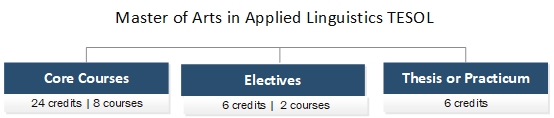
Master of Arts in Applied Linguistics TESOL

hauniv maal diagram


  • View the web page for the M.A. in Applied Linguistics TESOL program

Core Curriculum (8 courses, 24 credits – 48 ECTS)

The core courses balance a strong research-based foundation in Applied Linguistics with TESOL courses in order to assist novice and experienced teachers in developing their skills in the teaching and assessment of English Language learners from different cultural backgrounds.

{slider=AL01 Introduction to Applied Linguistics and Language Education}Provides students with an overview of the field of Applied Linguistics, its history, branches and scope. It offers the basis from which to pursue studies in various sub-fields such as language teaching and language testing. A current review of the state of the art is linked to the core purpose of resolving serious language based problems in society and how these insights enhance language use and language learning outcomes revealing the interdisciplinary nature of the field. Prerequisites: None. Credits: 3{/slider}

{slider=AL06 Understanding Research in Applied Linguistics}Provides an overview of research methods in Applied Linguistics. The course explores key issues in designing and implementing research projects, as well as analyzing results. Topics covered include data collection techniques, such as ethnographic observation, survey and interview design, as well as qualitative and quantitative data analysis. The course also facilitates comprehension of published research articles in the field and prepares students to make their own research contributions. Prerequisites: None. Credits: 3{/slider}

{slider=AL10 Intercultural Communication}Focuses on the importance of culture in education as well as in everyday life, and the ways in which culture interrelates with and affects communication. Further, it focuses on a discourse approach aiming to address and examine confusion in goals or in interpreting the main points of another person's speech caused by the fact that each side uses different principles of discourse to organize the way they speak. The course addresses the individual in the moment of taking social action with other people focusing on the various discursive resources available. The course helps learners communicate making sense of the world’s cultural, linguistic, ethnic and social diversity and through a variety of communication encounters helps them become more conscious of many of the actions and attitudes of the target language community. Prerequisites: None. Credits: 3{/slider}

{slider=AL11 Critical Discourse Analysis}Discusses the connection between language, power and ideology. The course seeks to discuss theories, techniques and methods which better realize and interpret this connection. It also describes the practices and conventions in texts (written and oral) which carry political and/or ideological weight. The course focuses on the understanding that meaning is generally communicated not only through language but also through other semiotic modes. Prerequisites: None Credits: 3{/slider}

{slider=TE02 Second Language Acquisition}Explores how second languages are learned and focuses on the relationship between teaching methods and second language acquisition theory. The course examines how learners create a new language system, what is learned of a second language, and what is not learned. It also covers the nature of learner hypotheses (conscious and unconscious) regarding the rules of the second language and why some learners are more successful than others. Prerequisites: None; Co-requisites: AL01 Credits: 3{/slider}

{slider=TE03 Teaching Reading and Writing in English to Speakers of Other Languages (ESOL)}Focuses on the teaching and researching of Reading and Writing of English for Speakers of Other Languages (ESOL). It examines the processes involved in reading and writing and the sub-skills required to master different levels of communicative competence. It looks at methods for designing reading and writing courses, selecting curricular materials and planning instruction. It also explores the essential role of systematic vocabulary development in L2 literacy, and includes practical methods for assessing L2 students’ proficiency, achievement, and progress in the classroom. Prerequisites: AL01, TE02 Credits: 3 {/slider}

{slider=TE04 Teaching Listening and Speaking to Speakers of Other Languages (ESOL)}This course examines the teaching and researching of listening and speaking and their sub-skills for Speakers of Other Languages (ESOL). Participants on the course are introduced to the theoretical background to these skills and relate this knowledge to its practical application in the classroom. They compare native and non-native oral production and reception, and investigate research into the sub-skills involved. They explore how language teachers can more effectively teach these sub-skills to L2 students and demonstrate their teaching competence through lesson planning and evaluation of teaching materials. Prerequisites: None; Co-requisites: AL01. Credits: 3{/slider}

{slider=TE13 Classroom Assessment and Language Testing}Focuses on the processes involved in in the assessment and teaching of English to Speakers of Other Languages (ESOL) in different contexts, including the teaching of English Learners (ELs) in the US state school system. It raises awareness of the relationship between language proficiency and use of English in social, academic and occupational contexts. It provides insights into the use of specific tools for producing, interpreting and reporting reliable and valid data to promote effective teaching and assessment. The course highlights the positive relationship between instruction and assessment. Prerequisites: AL01 Credits: 3{/slider}

Elective Seminars (2 courses, 6 credits – 12 ECTS)

Elective Seminars provide opportunities for students to pursue their interests in TESOL or Applied Linguistics. The list of Elective Seminars may change every year, depending on staff availability.

{slider=TE15 Online Teaching and Testing}The course introduces key principles and practices which govern the design and delivery of an online training program. It discusses the role of instructors and students operating in an online educational context. The course trains participants to become interactive, collaborative and engaging in virtual learning environments. Finally, the course helps participants design teaching and assessment material to accommodate both synchronous and asynchronous delivery.{/slider}

{slider=TE08TW Practicum - Tutoring Writing}The course is designed to provide students with a thorough understanding of the philosophy and practice of the Hellenic American University Writing Center. Throughout the course, students will be exposed to current tutoring practices and models as well as guidelines, techniques and tutoring activities, both onsite and online, that will assist them in dealing effectively with the challenging and rewarding experience of working at a Writing Center. An additional aim of the course is to help students develop their own tutoring skills and strategies and deepen their knowledge about the role of the Writing Center within a university. Each student will be mentored by Writing Center tutors who will observe them tutoring and act as a sounding board for your concerns. Prerequisites: AL01 Credits: 3{/slider}

{slider=TE11 Teaching English to Learners with Special Needs}Examines the characteristics of learning disabilities, emphasizing language and processing deficits and how they interfere with academic achievement and social relationships. The student will examine assessment and intervention approaches for students with learning disabilities as well as historical and cultural frameworks of the LD community. The course will have an applied element to it, as the student will be encouraged to collect their own data and share with the class in order to develop a deeper understanding of the actual nature of LD and interventions needed. Prerequisites: AL01 Credits: 3{/slider}

{slider=TE14 TESOL Management}This course is designed for TESOL professionals who have made, or who are planning to make, the transition into management in a language teaching operation and need to gain expertise in key areas of the academic manager’s role. The course provides training and development in clearly defined aspects of management such as customer service, human resources, innovation, marketing and finance. Participants will apply the knowledge they gain to plan an initiative in a language teaching operation (LTO). Prerequisites: AL01 Credits: 3{/slider}

Thesis (6 credits – 12 ECTS)

{slider=AL07 Thesis}At the end of the taught part of the course, students will be required to write a 12,000-word dissertation on a topic that will be agreed upon with their supervisor. Advice and guidance is given in formulating and refining the research topic, conducting research, analyzing data, literature review, and documentation of sources. The dissertation offers students the opportunity to carry out independent research in an area of their interest and to apply the knowledge and the skills they have acquired to the investigation of a particular issue or problem. Prerequisites: All required and elective courses Credits: 3{/slider}

OR Practicum (6 credits - 12 ECTS)

{slider=TE07 Practicum}The Practicum is designed for participants with little or no experience in teaching English to speakers of other languages (ESOL). The Practicum facilitates professional development. through supervised teaching in real language classrooms. Participants will observe experienced teachers of ESOL and contribute to post-lesson discussions. The experienced teacher also collaborates with the participants to develop their own lessons, which will be observed by the MAAL instructor. A major component of the practicum is the development of strong reflective teaching practices. Both the MAAL instructor and the experienced teacher give feedback, which guides the participant to be able to evaluate their own practice as an ongoing part of their professional development. The participant writes a journal during their practicum, which includes detailed lesson plans and rationale for their choice of materials and teaching techniques. They also write a reflective piece on the lessons they conducted and responses to post-lesson discussions. Prerequisites: All required and elective courses. Credits: 6{/slider}

11/17/2025

  1. Master of Arts in Translation (MAT)
  2. Master of Arts in Conference Interpreting (MACI)
  3. Master of Science in Psychology (MSPsy)
  4. Doctoral studies

Page 2 of 5

  • 1
  • 2
  • 3
  • 4
  • 5

Search by school

Social Sciences Business, Technology, and Engineering Arts and Sciences

Undergraduate Programs

  • BA in English Language & Literature
  • Bachelor of Music
  • BS in Business Administration
  • BS in Engineering
  • BS in Informatics
  • BS in Psychology

Graduate Programs

  • MA in Applied Linguistics
  • Doctoral Studies
  • MA in Conference Interpreting
  • MA in Translation
  • Master of Business Administration
  • MBA Rolling Cohort
  • MS in Informatics
  • MS in Psychology
  • MS in Sales Management
  • MS in Stress and Health Management

Admissions

  • Overview of Admissions
  • Undergraduate Applications
  • Graduate Applications
  • Non-degree Applicants
  • Transfers and Waivers
  • Financial Assistance
  • International Students

Student Services

  • Career Development
  • Counseling Center
  • Writing Center
  • Faculty Mentors
  • Civic Engagement
  • Alumni
  • Office of Student Affairs
  • The Student Council
  • Debate Team
  • ACES

About

  • Vision and Mission
  • Letter from the Dean of the Nashua Campus
  • Diversity, Equity & Inclusion Plan
  • University Values
  • University Administration
  • University Office Directory
  • Board of Trustees
  • Accreditation
  • The Athens Campus
  • Fact Sheet
  • Availability of Resources
  • Latest News
  • Contact Us
  • Data Privacy Policy
  • Cookies Policy
  • Non-discrimination Policy
  • Website Map
  • Contact Us
© 2025 Hellenic American University: 436 Amherst St, Nashua, NH 03063 USA - Tel.: +1 603 577 8700
Hellenic American University is not affiliated with, sponsored by or related to American University
  • Home
  • Academics
    • Undergraduate Programs
    • Graduate Programs
    • Certificate Programs
    • Course Catalog
    • School of Arts & Sciences
    • School of Social Sciences
    • School of Business, Technology & Engineering
    • Library
    • Faculty
    • Academic Calendars
    • Online Learning
  • Admissions
    • Overview of Admissions
    • Undergraduate Applications
    • Graduate Applications
    • Non-degree Applicants
    • Transfer Students
    • Financial Assistance
    • International Students
  • Student Services
    • Career Development
    • Counseling Center
    • Writing Center
    • Faculty Mentors
    • Civic Engagement
    • Office of Student Affairs
    • The Student Council
    • Debate Team
    • ACES
    • Alumni
    • Events Calendar
  • Research & Teaching
    • Research Institute
    • Conferences and Colloquia
    • Language Assessment
    • Center for Teaching Excellence
    • Research Ethics and Policies
  • Study Abroad
    • Overview of Study Abroad Programs
    • Study Abroad: Practical Details
    • Advanced Diploma in TESOL
    • Travel Study Programs
    • Academic Credits, Transcripts and Language Courses
  • About
    • Vision and Mission
    • Letter from the Dean of the Nashua Campus
    • Diversity, Equity, and Inclusion Plan
    • University Strategic Plan, 2022-2027
    • University Values
    • University Administration
    • University Office Directory
    • Board of Trustees
    • The Athens Campus
    • Academic Partnerships
    • Accreditation
    • Fact Sheet
    • Availability of Resources
    • Employment Opportunities
    • Latest News
    • Contact Us